Shuriken Rim
The process ran through company and market analysis, user profiling, and a structured ideation phase, moodboard, brainstorming and morphing, before converging on the Shuriken concept. SolidWorks was used to model, validate mechanically and design the production molds.
- Type
- Product Design
- Period
- Mar – May 2019
- Team
- Julen Rodriguez, Eder Sanz
- Client
- University Project
The Brief
Redesign an aluminium wheel rim for MAPSA that follows the design DNA of the SEAT Arona, sporty, versatile and modern, while meeting all production and mechanical requirements.
MAPSA manufactures aluminium wheel rims for cars and commercial vehicles. The existing model, DYNAMIC 43CM 17" 26/3 FR, needed a redesign aligned with SEAT's latest Arona SUV. SEAT, founded in 1950 and known for models like the SEAT 600, required a rim that spoke to both family versatility and driving dynamism.
Exploration
Two companies shaped the brief: MAPSA, an aluminium wheel rim manufacturer focused on work and innovation, and SEAT, a Spanish car brand founded in 1950. The target user became a couple aged 30–40 with two children, who had recently changed to a spacious, polyvalent car and cared about both practicality and aesthetics.
Product analysis — Minimum wall thickness: 3 mm, constraining how bold the blade geometry could become. Material: Al-Si alloy (7%) + Mg (0.3%), St (0.01–0.02%), Ti/B (0.02%). Production: fusion, low-pressure moulding, automatic RX control, thermic treatment, machining and painting.
Design Direction — few holes for aerodynamism, dynamic ramifications, different depths and finishes, straight lines: a modern and innovative look expressing modernity and exclusivity while respecting the SEAT Arona design language.
Ideation
A moodboard fixed the aesthetic direction: modern finishes, straight lines, aerodynamism, dynamic ramifications, different depths. The palette landed on matte blacks and metallic silvers. Morphing, inspiring from different objects, products and nature, generated a broad field of concepts.
A weighted matrix evaluated concepts against faithfulness to the brief, originality, feasibility and aesthetics. Three were developed further; Shuriken scored highest across all criteria.
Development
The chosen concept was modelled in SolidWorks and stress-tested with force and torsion simulations. The virtual rim passed all mechanical property validations. Six-part molds were then designed in SolidWorks to make the complex blade geometry manufacturable through low-pressure fusion casting. A physical prototype was 3D-printed, sanded, filled, painted and finished to verify the form at full scale.
The Solution — Choose to Have It All
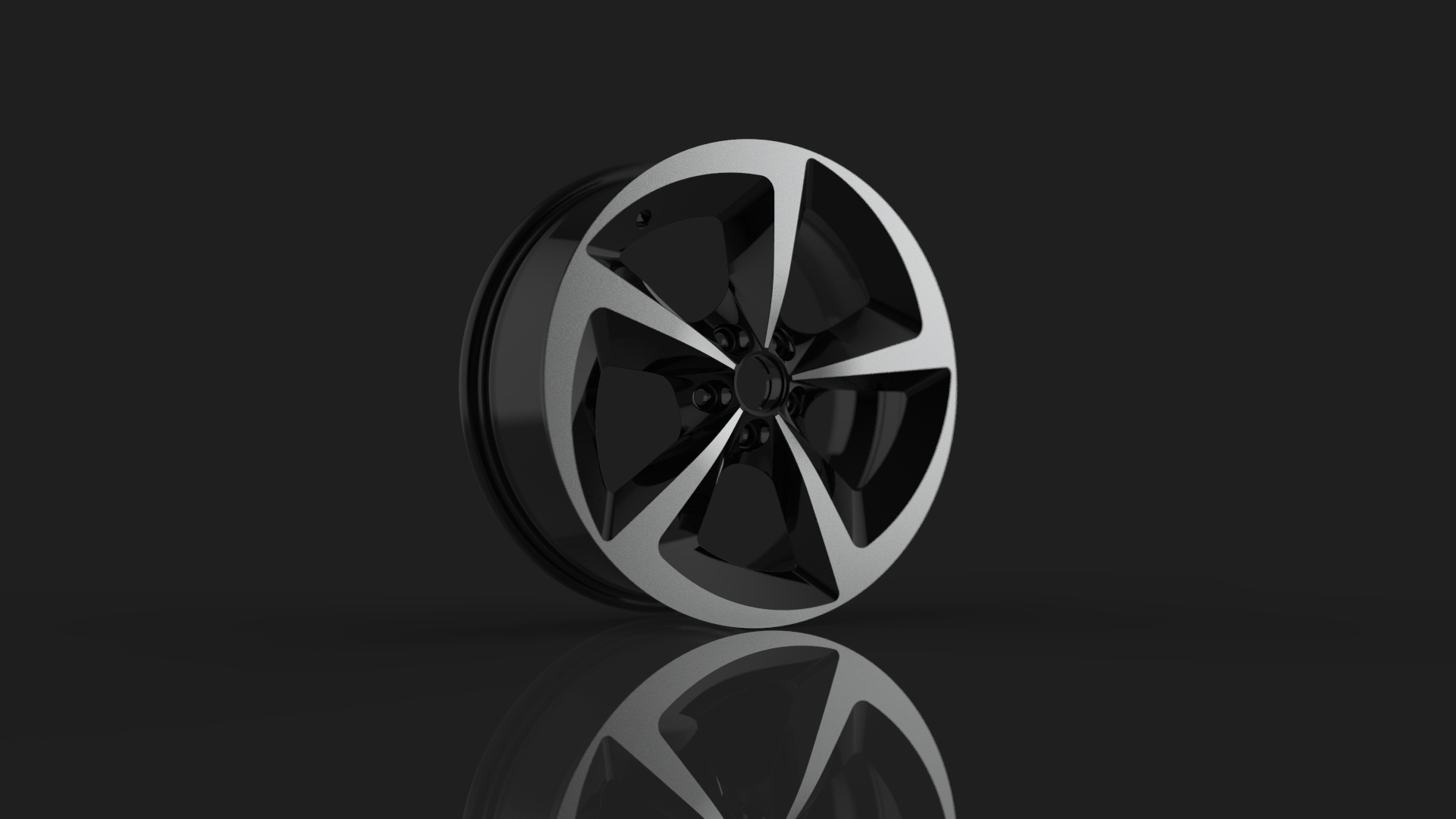
The Shuriken stands for "choose to have it all", a rim that bridges the family and sports worlds. Both design and name draw from Asian culture: the sharp radii recall ninja throwing weapons, flowing outward from the centre with a twist that hypnotises in motion. Dual finishes, matte black structure, machined metallic edge, complete the effect.
Materials — Al-Si Alloy Body: standard automotive-grade aluminium providing high strength at low weight. Matte Black Paint: applied to the blade structure, dried to a glossy-matte finish. Machined Metallic Edge: the outer rim edge is machined after painting, revealing the polished alloy for a dual-finish contrast effect.
Colours — Matte Black (#1a1a1a): communicates power, precision and modernity. Metallic Silver (#c0c0c0): applied to machined edges to create depth contrast and highlight sharpness.
Dimensions — Diameter: 43 cm / 17" · Model: 26/3 FR · Min. wall: 3 mm · Spokes: 5 blades · Mold parts: 6.
Prototype & Validation — a physical prototype was produced via 3D printing, followed by sanding, surface filling, spray painting and tape-masked metallic finishing, validating the form at full scale before any tooling investment.
Mechanically Validated — stress-tested in SolidWorks using force and torsion simulations, passing all mechanical property validations before any physical prototype was made.